


You’ve tried meal planning before. You spent a Sunday afternoon picking recipes, building a grocery list, maybe even prepping containers. By Wednesday, the plan fell apart, and on Thursday you were ordering takeout. By the following week, the whiteboard was blank and the unused kale had turned to slime in the crisper drawer.
You’re not bad at meal planning, you were just taught to do it wrong. Most people plan too many meals, pick recipes that don’t share ingredients, skip the prep step, and build a rigid schedule that crumbles the moment something unexpected happens.
We break down what actually works, backed by research on tens of thousands of adults, and walk you through a process designed to survive real life.
What Is Meal Planning (and Why It Should Work)?
Let’s start with the basics: meal planning is the practice of choosing what you’ll eat over a set period, usually a week, then shopping and prepping to match those choices. It turns a daily decision into a weekly one.
It’s important to not confuse meal planning with meal prepping, though the two work together. Planning is the “what” (picking your meals and buying ingredients), prepping is the “how” (washing, chopping, cooking ahead of time so weeknight dinners come together fast). You can do one without the other, but combining them is where the real time savings kick in.
How Much “Winging It” Costs

Most people don’t realize how much the nightly “what’s for dinner?” scramble actually costs them. It’s not just an annoyance, it’s a measurable drain on your time, your wallet, and your ability to eat the way you actually want to.
The EPA estimates that the average American throws away $728 per person per year in uneaten food. Those are mostly groceries you bought with good intentions that rotted because you never got around to cooking them. For a household of four, that’s over $2,900 in the trash annually.
On the other hand, meal planners cut that waste by roughly 40%, saving about $564 per person annually, totalling up to over $2,200 back in your pocket for the same household.
Then there’s the time. Survey data from Instacart shows that people who plan meals save roughly 5 hours per week compared to those who decide day by day. Five hours spent wandering grocery aisles, scrolling recipes at 5:45pm, and making last-minute store runs for the one ingredient you forgot.
And finally, there’s the impact that meal planning has on your diet. A study of 40,554 adults published in the International Journal of Behavioral Nutrition and Physical Activity found that meal planners had significantly better diet quality, ate a wider variety of foods, and had lower odds of being overweight or obese.
Let’s be honest, when you’re hungry and tired at 7pm, you’re not going to reach for a balanced meal, you reach for whatever’s fastest, and meal planning removes that failure point.
Why Your Last Meal Plan Fell Apart
Most people who quit meal planning don’t quit because the concept is flawed, they quit because they tried to do too much too fast. If you’ve tried meal planning and quit, you probably hit one of four walls. Knowing which one tripped you up is the first step to fixing it.
You Planned Too Many Meals
This is the most common mistake. You sat down on Sunday and mapped out breakfast, lunch, dinner, and snacks for seven straight days, that’s a total of twenty-one meals (+snacks). The cognitive load alone is enough to make the whole thing feel miserable, and when you inevitably deviate (a work lunch, a skipped breakfast….), the guilt spiral starts.
The fix is simple, start with dinners only. Three to five per week, that’s it. Leave room for a leftover night, a takeout night, and at least one “whatever’s in the fridge” night. Research from Brown University Health found that 73% of families who use weekly planners report significantly less mealtime stress. The key word is “weekly,” not “every meal.”
Once that feels routine (usually after three or four weeks), try adding lunches or breakfasts to your meal planning if you want to.
Your Plan Had Zero Flexibility
A late meeting, your kid gets sick, or you’re just not in the mood for salmon on Tuesday. Any of these small disruptions can blow up a rigid meal plan, and when the plan breaks, most people don’t adapt. They abandon it entirely.
Build in one or two “flex nights” each week. These are nights designated for leftovers, freezer meals, breakfast-for-dinner, or takeout. When something throws off your plan, you have a built-in cushion instead of a reason to give up.
You Picked Recipes That Don’t Work Together
One of the most common meal planning mistakes is choosing meals that share nothing in common. Five completely different meals often mean a long shopping list, higher food costs, and ingredients left unused at the end of the week.
A better approach is to pick recipes that share ingredients. If Monday’s stir-fry uses bell peppers and brown rice, find a Thursday recipe that uses one or both of those same ingredients again later in the week. Overlapping ingredients means a shorter grocery list, fewer items going bad, and money saved each week.
If your goal is variety and you’re stuck in a rut, there are plenty of meal planning ideas that can help you avoid repetition while still making the most of the ingredients you buy.
You Skipped the Prep Step
Planning what to eat is only half the equation. If you chose five great recipes but didn’t wash, chop, or pre-cook anything, you’re still starting from scratch every night. That’s when the plan tends to collapse, because the energy to cook a full meal from raw ingredients after a long day is just too high.
Batch prepping is what separates people who meal plan on paper from people who actually eat what they planned. One to two hours on a single day (Sunday works for most people) covers a full week. We’ll get into the exact process below.
The Four-Step Meal Planning Process That Actually Works

Meal planning comes down to four simple steps. None of them are complicated, and the value comes from doing all four together, in order, once a week. Get these right and you’ll spend less time, less money, and less mental energy on food every week.
Step 1: Pick Your Meals (But Fewer Than You Think)
Plan one week at a time, and start with three to five dinners. Anything longer gets unwieldy, and anything shorter doesn’t save you much effort. A good weekly plan also mixes familiar meals with new recipes. About 70% should be dishes you already know how to make and enjoy eating. The other 30% is your chance to try something new without the pressure of an entirely unfamiliar menu. This keeps the week manageable and prevents recipe fatigue.
Cooking for just yourself? The approach to meal planning for one is the same, but batch cooking becomes even more valuable because you can freeze half of everything and avoid the single-person trap of throwing out half a head of lettuce every week.
Your dietary style also shapes what goes on the list. If you follow a keto, vegan, Mediterranean diet, or high-protein diet, choose recipes that fit those parameters from the start. This is also where automation tools start earning their keep.
Tools like Eat This Much generate a full week of recipes based on your calorie target, macro split, and dietary preferences, which removes the hardest part of meal planning: deciding what to eat when you’re staring at a blank page.
Step 2: Build a Smarter Grocery List
A grocery list built from your actual meal plan is fundamentally different from one you scribble on the way to the store. Use a two-step process:
- Go through each recipe and write down every ingredient. This is your master list.
- Walk through your fridge, freezer, and pantry, crossing off anything you already have. What’s left is your actual grocery list.
Organize the list by store section (produce, dairy, proteins, pantry staples) so you’re not zigzagging and backtracking through the store. This alone cuts most grocery trips by 15 to 20 minutes. Buy proteins and grains in bulk when you’re using them across multiple recipes. Buy produce only for the current week, since most fresh vegetables start declining after five or six days.
Step 3: Prep on One Day
Batch prepping is what separates people who meal plan on paper from people who actually eat the meals they planned. Set aside one to two hours and knock out the prep work for the entire week.
Start with the foods that take the longest to cook. For example, brown rice needs 45 minutes. Dried beans need even longer. Roasted vegetables take 25 to 40 minutes depending on the cut. Get those going first, then move to quicker tasks like washing fresh vegetables and marinating proteins.
The way you store the food also matters. According to FoodSafety.gov, cooked poultry and ground meat last 1 to 2 days in the fridge. Cooked whole meats, fish, soups, and stews keep for 3 to 4 days. Hard-boiled eggs and chopped vegetables are good for about a week in airtight containers. Anything you won’t eat within those windows goes straight to the freezer. And make sure to label and date everything.
Step 4: Heat Up or Cook
If you’ve done steps 1 through 3, weeknight cooking drops to 15 to 20 minutes. Your vegetables are chopped, your rice is cooked, and your proteins are marinated or cooked. You’re essentially assembling and heating, not cooking from scratch. This is the payoff that makes the Sunday prep session worth it.
How to Make Meal Planning Work for Your Diet and Lifestyle
The meal planning process stays the same regardless of what you eat, and whether you follow a specific diet or not. The ingredient choices change, and some diets need extra attention in specific areas.
Keto and low-carb diets require careful planning because carbs hide in places you don’t expect. Sauces, marinades, and even some vegetables can push you over your carb limit if you’re not tracking. Planning your meals in advance lets you calculate net carbs before you cook, not after.
Vegan and vegetarian diets need intentional protein variety across the week. It’s easy to default to the same two or three protein sources (tofu, beans, and more beans) every night. A good meal plan spreads different sources across the week: lentils on Monday, tempeh on Wednesday, chickpeas on Friday, edamame in Saturday’s stir-fry.
High-protein and muscle-gain diets benefit from front-loading protein-rich meals on training days. If you train in the evening, plan your highest-protein dinner for those days. If you train in the morning, prep high-protein breakfasts you can grab fast.
💡 Use our protein inake calculator to help you find your exact protein target based on age, weight, and activity level.
Calorie-specific plans are where meal planning apps genuinely outperform manual planning. Whether you’re eating 1,500 or 2,500 calories a day, hitting a precise number consistently is nearly impossible without pre-calculating your meals.
Managing a health condition like type 2 diabetes or heart disease adds another layer. Meal planning helps you stick to the nutritional parameters your doctor or dietitian sets, and it removes the guesswork that leads to off-plan eating. If you’re in this category, work with a registered dietitian to build your framework, then use that framework to guide your weekly plans.
Tools That Make Meal Planning Easier
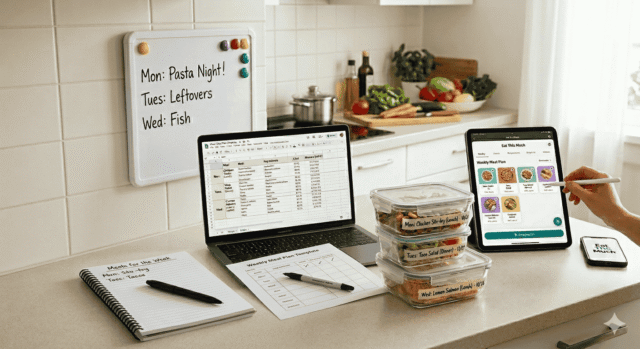
You don’t need fancy tools to meal plan, but the right ones speed things up considerably.
Pen and paper still works. A whiteboard on the fridge or a simple notepad is enough for people who plan 3 to 4 meals a week and don’t need to track calories or macros. It’s visual, it’s shareable (the whole household can see the plan), and it costs almost nothing.
Spreadsheets and templates work for detail-oriented planners who want to track ingredients, costs, and nutritional info. You can find free meal planning templates online, or build your own in Google Sheets.
Meal planning apps save the most time. Eat This Much generates a personalized weekly plan based on your calorie target, macro split, dietary restrictions, and budget. It creates an automated grocery list, integrates with Instacart and AmazonFresh for delivery, and syncs with Apple Health and Google Fit if you’re tracking fitness alongside nutrition. For most people, an app turns a 30-minute planning session into a 2-minute review.
Food storage containers are the unsexy but essential tool. Invest in a set of glass containers that are freezer-safe, microwave-safe, and have airtight lids. Label everything with the meal name and date. When your fridge is full of clearly labeled prepped meals, actually eating the food you planned becomes almost effortless.
Sample Weekly Meal Plan
Below is what a realistic week of dinners looks like. Ingredients overlap across meals, and two nights don’t require any cooking at all.
Monday: Sheet pan chicken thighs with roasted broccoli and brown rice
Tuesday: Black bean tacos with avocado, salsa, and leftover brown rice from Monday
Wednesday: Leftover chicken and brown rice turned into chicken fried rice with frozen vegetables and soy sauce
Thursday: Pasta with marinara, ground turkey, and a side salad
Friday: Flex night (takeout, leftovers, or breakfast for dinner)
Saturday: Slow cooker chili with cornbread
Sunday: Leftover chili, prep for next week
The chicken from Monday feeds Wednesday’s dinner. Thursday and Saturday introduce fresh proteins while leaning on pantry staples (pasta, canned tomatoes, dried beans) to keep costs low. Friday is the pressure valve. Sunday does double duty: dinner and prep for the week ahead.
Your ideal plan depends on your calorie needs, dietary preferences, and schedule.
So, Set Your Goals and Stop Planning to Fail
Your reason for meal planning shapes how you approach it, so pick one or two goals before you start mapping out recipes.
Maybe you want to cut your grocery bill. Maybe you’re trying to eat more vegetables and fewer drive-thru burgers. Maybe you’re managing type 2 diabetes and need to know exactly what’s on the plate. Or maybe you’re just sick of the nightly negotiation with your fridge. All of those are valid starting points.
The mistake most beginners make is trying to optimize for everything at once. They want cheaper groceries, perfectly balanced macros, zero food waste, and five new recipes a week. That’s a recipe for burnout. Pick goals that actually matter to you right now and let the rest come later.
The people who stick with meal planning long-term aren’t the ones with color-coded spreadsheets and 21 meals planned to the gram. They’re the people who planned a couple of dinners tostart off with, kept the schedule loose, prepped on Sunday, and didn’t beat themselves up when Wednesday went off-script.
Pick three dinners for this week, write down what you need, shop once, and prep what you can in one afternoon. That’s the whole system. Or, if you’d rather skip the planning step entirely, let Eat This Much generate your first week’s plan based on your goals. Either way, you’ll spend less time, less money, and less mental energy on food this week than last.
Frequently Asked Questions
What are the basic steps of meal planning?
Successful meal planning breaks down into four steps: choose your meals for the week, build a grocery list from those recipes, shop for the ingredients you don’t already have, and batch prep on one day so weeknight cooking is fast.
How much money can meal planning save?
The average American wastes around $728 per person per year on uneaten food. Meal planners reduce food waste by roughly 40%, saving around $564 per person annually. A family of four can expect to save over $2,200 a year.
Is meal planning good for weight loss?
Yes. A study published in the Annals of Behavioral Medicine found that meal planning was linked to more successful weight loss. Planning meals makes it easier to control portions and stick to calorie targets because you’re making food decisions once a week, when you’re thinking clearly, rather than every night when you’re hungry and tired.
How do I meal plan on a budget?
Start by planning meals around ingredients you already have, then choose recipes that share ingredients to limit food waste. Check what you have in your pantry before making a grocery list. Buying proteins and grains in bulk and opting for store brands can further reduce costs. And skip the pre-cut, pre-washed convenience items unless the time savings genuinely prevent you from cooking at all.
What’s the difference between meal planning and meal prepping?
Meal planning involves deciding what you’ll eat in advance and creating a shopping list to match. Meal prepping is the preparation stage, where you cook meals or prepare ingredients ahead of time. You can meal plan without meal prepping, but many people combine the two to save time, reduce food waste, and make healthy eating more convenient throughout the week.