


In your quest to manage cholesterol or improve heart health, you may wonder if a low-fat diet is the right choice for you. How much fat should you actually eat? Which fats are the real problem? What does this diet even look like in practice?
The choice to follow a low-fat diet requires understanding that not all fat is created equal. Some fat damages your heart, while other fat your body desperately needs. When you cut out everything, you end up constantly hungry and feeling terrible. That’s when most people give up and think the diet doesn’t work.
Please talk to your doctor or health professional before making any major changes to your diet plan.
Low-Fat Diet at a Glance
- Definition: Limits total fat to 30% or less of daily calories (about 67g on a 2,000 calorie diet)
- Focus: Reducing saturated and trans fats while maintaining unsaturated fats
- Primary benefit: Lower LDL cholesterol and reduced cardiovascular disease risk
- Not: A fat-free diet (healthy fats are still important)
- Best for: People with high cholesterol, heart disease risk, or certain digestive conditions
- Sustainability: Moderate low-fat diets work better than extremely restrictive versions
What Is a Low-Fat Diet?
A low-fat diet limits total fat to 30% or less of daily calories. This is different from no-fat diets or extremely restrictive diets, both of which are unnecessarily restrictive.
The diet emphasizes reducing saturated and trans fats specifically, not eliminating fat entirely. Unsaturated fats from sources like olive oil, nuts, and fish are included in moderate amounts because they provide nutritional value and support satiety.
The low-fat diet originated from cardiovascular disease prevention research and remains recommended by the American Heart Association for people with high cholesterol or heart disease risk.
Low-Fat vs Low-Carb: What’s the Difference?
Low-fat diets focus on saturated fat reduction for heart health, while low-carb diets focus on blood sugar and metabolic changes. Both can support weight loss when overall calories are appropriate.
| Low-Fat Diet | Low-Carb Diet | |
|---|---|---|
| Primary focus | Reducing saturated and trans fats | Reducing carbohydrates |
| Fat intake | 25-30% of calories | 50-70% of calories |
| Carbs | 45-65% of calories | 20-50% of calories |
| Best for | High cholesterol, heart disease | Metabolic health, weight loss |
| Protein | Moderate (15-20%) | Moderate to high (20-30%) |
| Sustainability | High (fewer restrictions) | Moderate (requires adjustment) |
Want an easier way to stick to a low-fat diet? Get a free, fully customized low-fat meal plan that keeps your fat, calories and nutrients on track.
Types of Fats and Why They Matter
Not all fats are created equal. Understanding the difference helps you make smart choices instead of cutting fat indiscriminately.
Saturated Fat
Found in fatty meats, butter, cheese, and coconut oil, saturated fat raises LDL cholesterol (“bad” cholesterol) and increases cardiovascular disease risk. The American Heart Association recommends limiting saturated fat to less than 7% of total calories.
On a 2,000 calorie diet, that’s about 16g of saturated fat daily, which is less than most people consume.
Trans Fat
Found in partially hydrogenated oils used in processed baked goods, fried foods, and some margarines, trans fat increases heart disease risk more than saturated fat. Most countries have banned or severely restricted trans fats due to health evidence.
Limit trans fat to less than 1% of daily calories (under 2g daily on a 2,000 calorie diet).
Unsaturated Fats
Found in olive oil, avocado oil, nuts, seeds, and fatty fish, unsaturated fats are considered heart-healthy when used in moderation. These fats lower LDL cholesterol and support brain and heart health.
Include unsaturated fats in your low-fat diet, but control portions since all fats are calorie-dense (9 calories per gram).
How Much Fat Should You Eat?
A general, balanced diet typically includes 20–35% of calories from fat. A low-fat diet sits at the lower end of that range, usually around 20–30%.
Calculating Your Target
To calculate your fat target, multiply your daily calorie intake by your chosen fat percentage, then divide by 9 to convert calories into grams.
Example:
2,000 × 0.30 = 600 calories from fat ÷ 9 = 67g per day
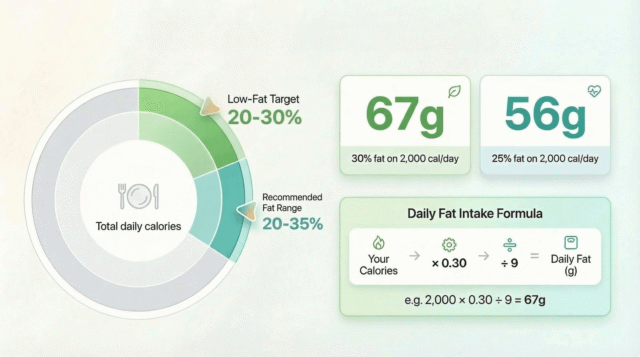
Which means that on a 2,000 calorie low-fat diet, that works out to about 67g at 30%, or roughly 56g at 25%.
Setting a clear target helps you stay consistent without cutting fat too aggressively or guessing what “low-fat” should look like.
Why Reduce Saturated Fat?
Saturated fat raises LDL cholesterol, the form that damages artery walls. Reducing saturated fat intake lowers LDL levels and improves overall cholesterol profile.
Research shows that reducing saturated fat intake by 1% of daily calories lowers LDL cholesterol by approximately 1.3 mg/dL. While modest per 1% reduction, the cumulative effect of reducing saturated fat from 12% to 7% of calories shows meaningful improvement.
Lower LDL cholesterol reduces cardiovascular disease risk by approximately 20-30% depending on starting levels.
Health Benefits of a Low-Fat Diet
There are several well-documented benefits to following a low-fat diet, especially when the focus is on reducing saturated fat and prioritising whole foods.
Improved Cholesterol Levels
One of the most consistent changes people see is improved cholesterol levels. Lowering saturated fat can reduce LDL cholesterol and triglycerides, and improve your overall cholesterol profile. These shifts often begin within just a few weeks of making consistent dietary changes.
Reduced Cardiovascular Disease Risk
There is also strong evidence linking lower LDL cholesterol to reduced cardiovascular risk. For individuals with elevated cholesterol, a well-structured low-fat diet has been associated with reducing heart disease and stroke risk by approximately 20-30%.
Weight Management Support
Reducing fat can lower the overall calorie density of meals, which makes it easier to eat slightly less without feeling deprived. When vegetables, whole grains, and lean proteins make up the majority of the diet, maintaining a calorie deficit tends to feel more manageable. That said, calorie balance still determines whether weight loss occurs.
Medical Condition Support
Low-fat diets can also be helpful in specific medical situations. People with gallbladder issues, fat malabsorption, or certain digestive conditions may experience symptom relief when fat intake is reduced to levels their body can tolerate more comfortably.
Potential Downsides of a Low-Fat Diet
A low-fat diet can offer real benefits, but it is not automatically better just because fat is reduced. Problems usually arise when fat intake is pushed too low or when fat is replaced with highly processed carbohydrates. Understanding the potential downsides helps you avoid common mistakes and structure the diet in a way that remains balanced and sustainable.
Reduced Satiety
Extremely low-fat diets (below 20% of calories) may increase hunger and cravings, making it difficult to stick with them. Moderate low-fat diets (25-30%) typically maintain adequate satiety.
Fat-Soluble Vitamin Absorption
Vitamins A, D, E, and K require dietary fat for absorption. Extremely restrictive fat intake impairs absorption of these essential vitamins, which is why some fat is necessary.
Hormonal Effects
Extremely low fat intake (below 15% of calories) may interfere with hormone production, particularly in women. Moderate fat intake is necessary for hormonal balance.
Not Ideal for Everyone
Athletes requiring high calorie intake may struggle with low-fat diets’ lower calorie density. People with certain genetic lipid profiles may not see cholesterol improvements despite following a low-fat diet.
Common Misconceptions and Mistakes
One of the biggest misconceptions about the low-fat diet is that all you’re eating is salad and steamed vegetables. This isn’t the case. It’s important to remember that this should still be a very balanced diet, consisting of proteins, carbohydrates, and healthy fats.
The second big misconception is that low-fat diets will leave you weak and malnourished. Note that this can happen if you aren’t careful. But a well-balanced and planned out low-fat diet does not have to lead to this. You can get all the nutrients you need through a low-fat diet as long as you eat a wide variety of foods and possibly take a few key supplements. This will help you make up for any nutritional gaps and keep your energy level high at all times.
What to Eat on a Low-Fat Diet
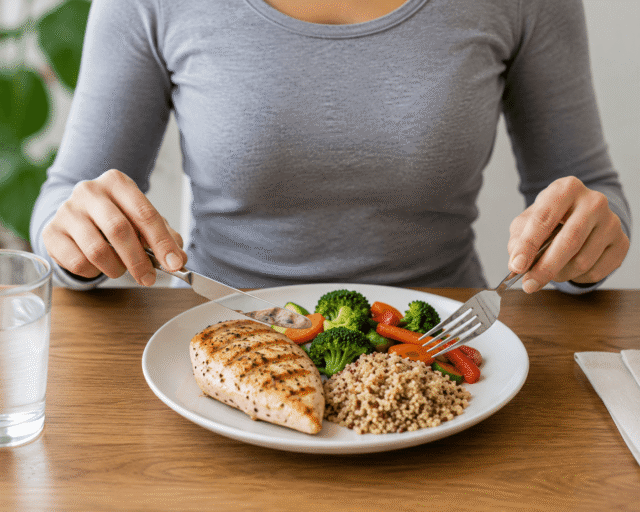
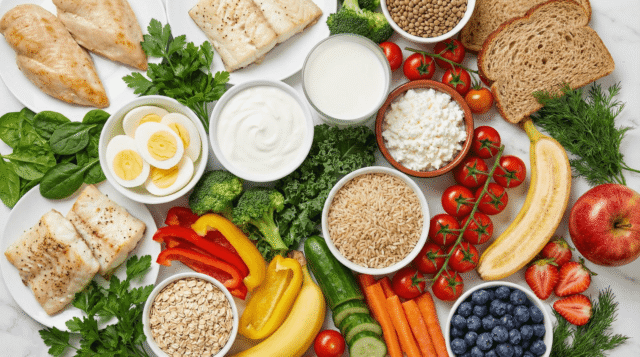
A low-fat diet emphasizes whole foods naturally low in saturated fat while providing nutrients and satiety. This doesn’t mean eating only salad and vegetables, there is a wide variety of foods you can eat to build balanced, satisfying meals while keeping fat intake under control.
- Fruits and vegetables are naturally low in fat and high in fiber, which supports satiety and blood sugar stability. Eat a variety of colors for diverse nutrients.
- Whole grains like oats, brown rice, whole wheat bread, and quinoa provide fiber and nutrients while being very low in fat.
- Lean proteins including skinless chicken and turkey, fish (especially fatty fish like salmon for omega-3s), beans, lentils, and tofu provide protein without excess saturated fat.
- Low-fat or fat-free dairy like skim milk, low-fat yogurt, and reduced-fat cheese provides calcium and protein while limiting saturated fat.
- Healthy fats in small portions including olive oil (1-2 tbsp per meal), avocado (quarter to half per meal), and nuts (small handful as snack) provide essential fatty acids and nutrients while keeping total fat moderate.
Foods to Limit or Avoid
- Fatty meats including bacon, sausage, marbled beef, and ribs are high in saturated fat and should be replaced with lean cuts or plant-based proteins.
- Full-fat dairy including whole milk, cream, butter, and full-fat cheese should be replaced with low-fat or fat-free versions.
- Fried foods are high in calories and often contain trans fats from cooking oils, so choose baked, grilled, or steamed preparation instead.
- Baked goods often contain partially hydrogenated oils or excess saturated fat, so read labels and choose whole grain options with minimal fat.
- Highly processed snacks including chips, cookies, and pastries are calorie-dense with minimal nutrition, so choose fruit, vegetables, or nuts instead.
Cooking and Eating Strategies for a Low-Fat Diet
Eating low-fat isn’t just about what you buy, it’s also about how you cook and order your food. Small, practical adjustments at the supermarket, in your kitchen, and when eating out can significantly reduce saturated fat without making meals feel restrictive.
The goal isn’t to strip flavour from your food, but to make simple swaps and choices that lower fat intake naturally while keeping meals satisfying.
At the Grocery Store
- Choose lean cuts of meat explicitly labeled “lean” or “extra lean” to reduce saturated fat automatically.
- Compare nutrition labels to find options lower in saturated fat per serving, as brands vary significantly.
- Read ingredient lists for trans fats, which may appear as “partially hydrogenated oils” even if the nutrition label shows 0g trans fat (due to rounding rules).
At Home
- Bake, grill, steam, or boil instead of frying to eliminate added fat from cooking methods.
- Trim visible fat from meat before cooking to reduce saturated fat content.
- Use non-stick cookware to reduce the need for added cooking oils.
- Flavor food with herbs, spices, lemon juice, and vinegar instead of oil-based sauces.
Eating Out
- Choose grilled, baked, or steamed options instead of fried preparations.
- Request sauces, dressings, and butter on the side so you control portions.
- Select vegetable-based sides instead of fries or cream-based dishes.
- Ask for lean protein options like fish or skinless chicken.
7-Day Low-Fat Meal Plan
This is a flexible template that you can adjust based on preferences and availability.
| Breakfast | Lunch | Dinner | Snack | |
|---|---|---|---|---|
| Monday | Oatmeal with berries and almond milk | Grilled chicken breast with brown rice and steamed broccoli | Baked cod with sweet potato and green beans | Apple with small amount of almond butter |
| Tuesday | Whole grain toast with avocado and egg white | Lentil soup with whole grain bread | Turkey meatballs with pasta and tomato sauce | Greek yogurt with berries |
| Wednesday | Low-fat yogurt with granola and fruit | Grilled fish with quinoa and roasted vegetables | Chicken stir-fry with brown rice and mixed vegetables | Carrot sticks with hummus |
| Thursday | Vegetable omelet with whole wheat toast | Bean and vegetable salad with olive oil dressing | Lean ground turkey with whole wheat pasta and marinara | Orange and small handful of almonds |
| Friday | Smoothie with skim milk, banana, berries, and oats | Grilled chicken salad with olive oil vinaigrette | Baked white fish with roasted root vegetables | Popcorn (air-popped) |
| Saturday | Whole grain pancakes with fruit | Lentil and vegetable stir-fry with brown rice | Lean beef and vegetable kebabs with whole grain pita | Low-fat yogurt with granola |
| Sunday | Veggie and egg white scramble with whole grain toast | Turkey and vegetable soup | Grilled chicken with quinoa and steamed vegetables | Fruit salad |
Creating balanced low-fat meal plans that hit your fat targets and nutrient needs takes planning. If you want a low-fat meal plan personalized to your needs, automatically generate one complete with recipes and a grocery list with Eat This Much.
Is a Low-Fat Diet Right for You?
This diet is well suited for those who have been instructed by their doctor to reduce cholesterol, those with established heart disease or significant heart disease risk, and those with certain digestive conditions that require fat restriction for symptom management.
It’s also well-suited for those who have very strong personal beliefs about heart health and who are motivated to make dietary changes to support their health.
Getting Started On a Low-Fat Diet
Much like other diets, many who follow it find it’s best to start gradually by devoting one day or even one meal a week to low fat options when starting out. Even once you find yourself comfortable with a low-fat diet, eating something with more fat on occasion isn’t the end of the world. Don’t be hard on yourself if you stray a little. After all, diets are about exploration and discovering what works best for you and helps you reach your health goals.
If you are someone who has decided you want to get started on a low-fat diet, the first step is to familiarize yourself with the lean protein sources that you can include regularly. Know these in and out so that it becomes easy to meet your protein needs without a problem.
Once you’ve got that down, be sure to take the time to plan out your meals for each day. This will help you ensure you get the nutrients you need. With a low-fat diet, you don’t want to just “wing it” and plan meals on the go. Do that and there’s a good chance you’ll have an imbalanced diet. Have some easy-to-make meals and snacks that you can turn to when life gets busy. This will really help save the day.
There’s plenty of reasons to try a low-fat diet, but if you need a little more support, we got your back! Try Eat This Much for free and let us simplify your meals while keeping your fat intake, calories and nutrients balanced.
The Bottom Line
A low-fat diet limits total fat to 30% or less of daily calories while emphasizing reduction of saturated and trans fats specifically. The diet is supported by research for lowering LDL cholesterol and reducing cardiovascular disease risk in people with high cholesterol or heart disease.
Extremely low-fat diets (below 15% of calories) are unnecessarily restrictive for most people and may impair nutrient absorption and hormonal balance. A moderate low-fat approach (25-30% of calories) balances heart health benefits with nutritional adequacy and satiety.
Success depends on consistency, prioritizing whole foods, and choosing lean proteins with unsaturated fats in moderate portions. The best low-fat diet is one you can maintain long-term for sustained cholesterol improvement and heart health.